S58 Daily Driver Power Guide: Build Reliable Power in the Right Order
If you are building an S58 for real street use, power is only half the equation. The goal is repeatable performance without turning your car into something annoying to drive every day.
This guide covers a practical upgrade order for S58 owners in G80 M3, G82 and G83 M4, G87 M2, and F97 and F98 X3M/X4M platforms.
Why the Order Matters
Most problems on tuned S58 cars are not from one bad part. They come from poor upgrade sequencing. If you push boost before handling airflow and heat, the car feels fast for one pull and soft on every pull after that.
A proper sequence gives you:
- Cleaner power delivery
- Better heat control
- Lower knock activity
- More consistent performance in real weather
Step 1: Baseline Health Check Before Tuning
Before adding power, verify the engine and supporting systems are ready.
- Scan for faults and shadow codes
- Confirm maintenance is current
- Check for boost or charge leaks
- Replace plugs if service interval is due
A baseline is not optional. It is what keeps a tuned car stable.
Step 2: Stage 1 Calibration for Daily Use
Stage 1 is usually the best first step for an S58 daily driver. You get a major torque increase, stronger midrange, and better top-end pull without forcing a big hardware jump on day one.
At this stage, keep the goal simple: smooth power, safe timing, and predictable drivability.
Step 3: Downpipes and Stage 2 Power
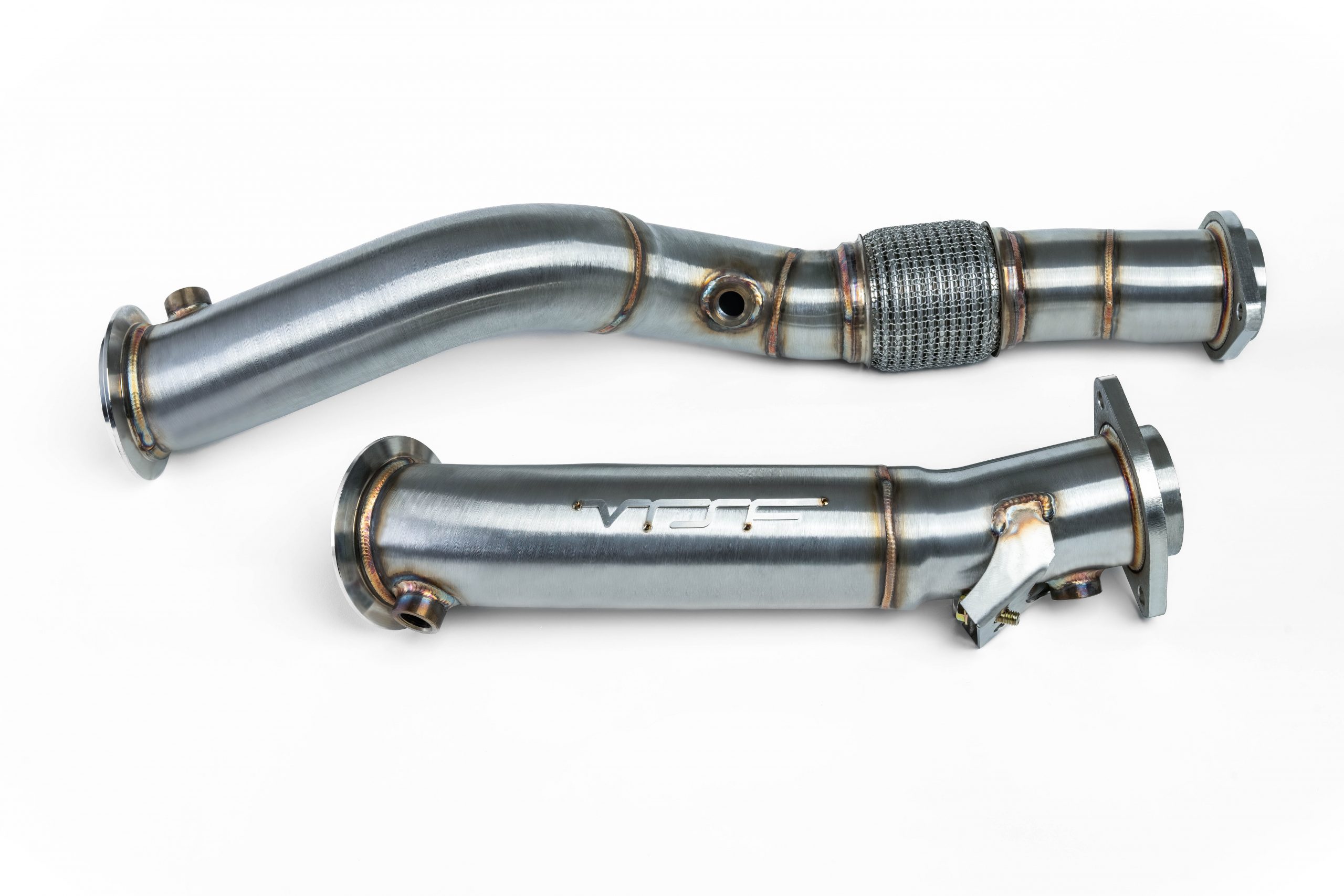
Once you want more than Stage 1 output, downpipes become one of the highest impact upgrades on this platform. Less backpressure improves spool behavior and unlocks stronger tuned gains.
S58 options currently in stock on Redline:
- VRSF Racing Downpipes S58 2020-2025 BMW M3/M4 G80 G82 G83
- VRSF Racing Downpipes S58 2019-2024 BMW X3M/X4M F97 F98
- VRSF Catted Downpipes S58 2019-2024 BMW X3M/X4M F97 F98
After hardware changes, run a tune revision matched to your exact setup and fuel.
Step 4: Cooling and Repeatability
The fastest dyno graph is not always the fastest street setup. If intake and charge temperatures climb, the ECU will protect the engine and reduce delivered power.
If your target is repeatable performance, cooling support should be part of the build plan, not an afterthought.
Step 5: Tires, Brakes, and Real-World Usability
More torque exposes weak points quickly.
- Use a tire that can hold torque in lower gears
- Keep brake performance aligned with speed increase
- Keep alignment and suspension setup in check
A balanced S58 setup is faster point to point than a peak-number-only build.
Common S58 Build Mistakes
- Installing parts without a clear power target
- Running aggressive maps on inconsistent fuel
- Skipping tune revisions after hardware changes
- Chasing peak numbers while ignoring heat management
Avoid these and the platform is extremely rewarding.
A Practical S58 Upgrade Path
- Baseline inspection and maintenance
- Stage 1 calibration
- Downpipes and matching tune revision
- Cooling support as power goals rise
- Tire and brake setup for controlled delivery
Final Take
The S58 can make serious power while staying street-friendly, but only if the build order is right. If you want help selecting the correct parts for your exact chassis and goals, we can map a setup that prioritizes reliability and usable performance.
Start with the S58 downpipe options above, then build around a calibration strategy that matches your fuel and driving use.